Lost in Hanoi’s Pulse: Where Every Corner Tells a Story
Hanoi isn’t just a city on a map—it’s a living, breathing rhythm of motorbikes, street food sizzles, and ancient alleys humming with history. I wandered without a full plan and discovered that the real magic lies in the moments between guidebook highlights. From dawn pho stands to lantern-lit water puppet shows, Hanoi doesn’t just welcome you—it pulls you into its flow. This is travel that sticks to your skin and echoes in your memory long after you leave. The city resists neat categorization, defying the structured itineraries many travelers rely on. Instead, it invites immersion, rewarding those who listen closely, move slowly, and allow themselves to be carried by its pulse. For women between 30 and 55—often balancing family, work, and personal dreams—Hanoi offers a rare kind of freedom: not escape, but reconnection.
The First Beat: Stepping Into Hanoi’s Sensory Overload
Arriving in Hanoi for the first time is less like landing in a foreign capital and more like stepping into a vivid dream where sound, scent, and motion blur into one continuous experience. The moment you exit Noi Bai International Airport, the city’s rhythm begins to seep in. The warm, humid air carries a layered aroma—grilled meat, diesel fumes, jasmine blossoms, and the faint tang of fish sauce—all swirling together in a scent that, surprisingly, becomes comforting over time. As you draw closer to the city center, the symphony of motorbike engines grows louder, a constant hum that never truly fades, even in the quietest hours of early morning.
For many, the most immediate challenge is crossing the street. Unlike cities with predictable traffic patterns and long stretches of green lights, Hanoi operates on a fluid, almost intuitive system. Thousands of scooters weave in and out with astonishing speed, yet rarely collide. Locals cross with calm determination, stepping off the curb at a steady pace, trusting that the flow will part around them. At first, it feels reckless—perhaps even terrifying—but soon, you learn the unspoken rule: move with confidence, maintain your path, and do not stop. It’s not about bravery; it’s about synchronization. When you finally make it across, there’s a quiet triumph, a first victory in the art of becoming part of Hanoi’s rhythm.
This sensory immersion isn’t accidental—it’s the essence of Hanoi. The city does not cater to the cautious or the overly planned. It rewards those who surrender to its chaos, who allow themselves to be overwhelmed before finding their footing. The narrow streets of the Old Quarter, each historically named after the trade once practiced there—Hang Gai (silk), Hang Bac (silver), Hang Ma (paper offerings)—wind like veins through the city’s heart. Here, colonial-era buildings with peeling yellow facades stand shoulder to shoulder with modern cafés and family-run shops. Banners flutter above, clotheslines stretch between balconies, and children dart through gaps in traffic with practiced ease. Every detail tells a story, not of perfection, but of life lived fully, messily, and authentically.
For the woman used to managing schedules, meals, and household rhythms, this initial disorientation can be both disarming and liberating. There is no need to control everything. In fact, trying to do so only heightens the stress. Hanoi teaches a different kind of competence—one rooted in observation, patience, and trust. As the days pass, the noise softens into background music. The crowds become familiar, even friendly. And what once felt like chaos begins to reveal its own kind of order, a complex, breathing system that runs on human connection more than rules.
Morning Rituals: Following the City’s True Locals
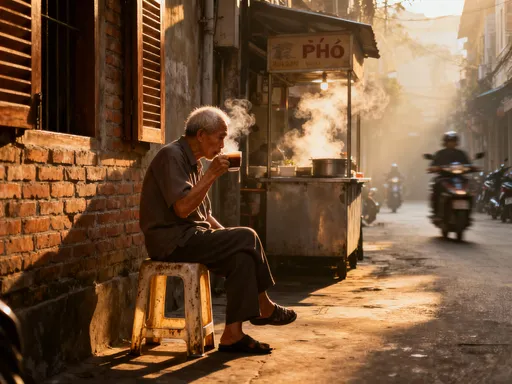
To truly know Hanoi, one must rise with it. By 5:30 a.m., the city is already awake, stirring with a quiet energy that hums beneath the surface. In small clusters along sidewalks and tucked into alleyways, clusters of tiny plastic stools appear like overnight mushrooms, occupied by locals beginning their day with ritual precision. This is not the time for grand sightseeing or museum visits—it is the hour of pho, coffee, and community. The steam rising from wide ceramic bowls carries the scent of simmered beef bones, star anise, and fresh herbs, a fragrance so rich it feels like nourishment before the first bite.
Pho is more than breakfast in Hanoi—it is a daily act of care, a moment of pause before the day’s demands take over. Families, office workers, and elderly couples gather at roadside stalls, often returning to the same vendor for years. The best spots are rarely marked by signs or seating; instead, they are recognized by the line of motorbikes parked neatly at the curb and the steady rhythm of the cook lifting lids, slicing meat, and ladling broth. One such place, near Hoan Kiem Lake, has served the same recipe for over four decades. The owner, a woman in her sixties with hands worn from years of chopping, knows her regulars by name and adjusts their orders without being asked—less onion for Mr. Thanh, extra basil for the schoolteacher who comes every Tuesday.
A few blocks away, another morning ritual unfolds in West Lake, where residents gather in small parks to practice tai chi, stretch, or play chess beneath the shade of banyan trees. The movements are slow, deliberate, grounding. There is no rush, no competition—only the quiet focus of breath and balance. Nearby, a group of women in their fifties laughs over a game of shuttlecock, their feet flicking the weighted birdie back and forth with surprising agility. These are not performances for tourists; they are moments of ordinary life, repeated day after day, season after season. To join them, even silently, is to be welcomed into a rhythm older than any guidebook.
For the traveler seeking connection, participating in these routines offers something deeper than a curated tour. It is not about ticking off attractions, but about presence. Sitting on a low stool with a cup of egg coffee—its thick, custard-like foam made from whipped egg yolk, sugar, and condensed milk—feels like a small luxury, a moment of indulgence earned simply by being there. These mornings are not loud or flashy, but they are profoundly peaceful. They remind us that life’s richest moments often come not from grand achievements, but from small, repeated acts of care—for food, for body, for community.
The Art of Getting Lost: Exploring Hanoi’s Hidden Alleys
One of the greatest gifts Hanoi offers is the joy of getting lost—intentionally, joyfully, without fear. While maps and apps have their place, they cannot capture the serendipity of turning down a narrow lane simply because the scent of grilled scallions draws you in or because a patch of sunlight falls perfectly across an old wooden door. The city’s charm lies not in its monuments, but in its in-between spaces—the quiet courtyards, the family-run repair shops, the hidden temples tucked behind unmarked gates.
Wandering without a destination allows you to slow down, to notice. You might stumble upon a grandmother fanning a charcoal brazier outside her home, roasting sweet potatoes for passersby. Or you might hear the rhythmic tapping of a cobbler shaping leather by hand, his stall no larger than a closet. In one alley near Hang Gai Street, a family spends hours making rice paper for banh cuon, their hands moving with a precision born of generations. The translucent sheets dry on bamboo mats under the sun, delicate as lace. When they offer you a taste—steamed and filled with minced pork and mushrooms—it is warm, tender, and unforgettable.
These discoveries are not found in brochures. They require time, curiosity, and a willingness to move slowly. The key is not to rush, but to observe. A smile, a nod, a quiet “xin chào” (hello) goes a long way. Locals appreciate the respectful traveler—the one who does not point or photograph without permission, but who pauses, watches, and acknowledges the humanity in everyday work. In return, they often offer small gestures: a shared seat, a piece of fruit, an invitation to watch a child’s first steps in a doorway.
Getting lost also means embracing uncertainty. You may find yourself at a dead end, or momentarily disoriented in a maze of alleys. But in those moments, something shifts. The pressure to perform, to optimize, to achieve, begins to dissolve. Instead, there is space—to breathe, to notice the way light filters through laundry lines, to hear the distant chime of a bicycle bell. For women who often carry the weight of planning and responsibility, this kind of freedom is rare. It is not neglect, but release. Hanoi teaches that not every moment must be productive to be meaningful. Sometimes, the most valuable experiences are the ones you never intended to have.
Hands-On Heritage: Crafting with Local Artisans
Hanoi’s soul is woven into its crafts, preserved not in museums, but in the hands of artisans who continue traditions passed down through generations. To engage with these crafts is to touch the living history of Vietnam—to see how silk is spun, how ceramics are shaped, how paper is made from bark. Unlike passive sightseeing, participating in a workshop transforms travel from observation to connection.
One of the most renowned destinations is Van Phuc Village, located just outside the city, where silk weaving has flourished for over a thousand years. Rows of looms line family homes, their rhythmic clatter filling the air. Women and men work side by side, their fingers guiding threads with practiced ease. Visitors can try their hand at weaving, learning the basics of tension and pattern. It is harder than it looks—each movement must be precise, each thread accounted for. But with guidance, even a beginner can create a small piece of fabric, imperfect but deeply personal. The silk, dyed with natural pigments from plants and roots, shimmers in the light, a testament to patience and skill.
Another destination, Bat Trang, is a centuries-old ceramics village along the Red River. Here, families shape clay into bowls, vases, and teapots using techniques unchanged for generations. Workshops welcome visitors to try pottery on the wheel or paint designs by hand. The experience is tactile and grounding—your hands covered in cool, wet clay, the quiet focus required to keep the spinning form centered. One artisan, a woman in her fifties, explains that her family has worked with clay for eight generations. “It’s not just a job,” she says. “It’s who we are.”
These experiences are not staged for tourists. While some studios cater to short visits, the best are those where craft remains central to daily life. Transportation is straightforward—taxis or motorbike taxis (xe om) can take you there in under an hour. Language may be a barrier, but gestures and smiles bridge the gap. Pricing is generally fair, with workshops ranging from $15 to $30, often including materials and a small keepsake. The real value, however, is not in what you take home, but in what you carry within—the memory of creating something with your hands, of connecting across cultures through shared effort.
Taste as a Language: Street Food Beyond the Plate
In Hanoi, food is more than sustenance—it is conversation, history, and identity served on a plate. To eat here is to participate in a daily ritual that transcends language. Ordering a banh mi from a street cart is not a transaction; it is a small exchange of trust, a shared understanding between stranger and vendor. The woman behind the cart knows how much chili you like. The pho seller remembers your preference for tendon or brisket. These micro-interactions, brief but meaningful, form the fabric of Hanoi’s social life.
The city’s most iconic dishes are rooted in resilience and resourcefulness. Pho, now beloved worldwide, began as a humble street meal for laborers, its rich broth a way to stretch scraps of meat into something nourishing. Bun cha, grilled pork served with rice noodles and herbs, is said to have been a favorite of former U.S. President Barack Obama during his visit—though locals have been enjoying it for decades at tiny sidewalk stalls. Egg coffee, invented during a milk shortage in the 1940s, turns scarcity into luxury, its creamy foam a decadent surprise.
For travelers, the best meals are rarely found in restaurants with menus in English. Instead, they happen at plastic stools by the roadside, where the only choices are pointing and smiling. Hygiene is a valid concern, but most reputable stalls maintain clean practices—watch for busy ones with high turnover, where food is fresh and hot. Wash hands before eating, and stick to bottled water. Ordering etiquette is simple: arrive, sit, and wait to be noticed. There is no rush. The food will come when it’s ready.
More than flavor, it is the context that makes Hanoi’s food unforgettable. Eating under a string of lanterns as motorbikes buzz past, sharing a table with strangers during a sudden rainstorm, learning to roll a spring roll from a grandmother in her kitchen—these are the moments that linger. For women who often feed others before themselves, Hanoi offers permission to savor, to indulge, to eat without guilt. Here, food is not duty—it is joy, connection, and celebration.
Beyond the Old Quarter: Day Trips That Deepen Perspective
While the Old Quarter pulses with energy, stepping outside Hanoi reveals a different side of northern Vietnam—one of quiet villages, misty mountains, and spiritual depth. These day trips do not require luxury tours or long journeys, but they offer profound contrast and context, enriching your understanding of the country’s cultural and natural landscape.
One of the most accessible destinations is the Perfume Pagoda, a complex of Buddhist temples and shrines nestled in the limestone hills southwest of the city. Reached by a scenic boat ride along a quiet river, followed by a cable car or a climb up stone steps, the site is especially peaceful in the early morning. Incense smoke curls into the air, bells chime softly, and pilgrims light candles in quiet devotion. It is not a place of spectacle, but of stillness—a reminder of the spiritual undercurrents that shape Vietnamese life.
Another rewarding journey is to rural villages like Duong Lam, one of Vietnam’s officially recognized ancient villages. Here, centuries-old houses made of laterite stone stand beneath banyan trees, and farmers tend rice fields much as their ancestors did. Children wave from bicycles, elders sit in doorways shelling peas, and the pace is measured, unhurried. A visit here is not about buying souvenirs, but about witnessing continuity—a way of life that persists despite modernity.
For those with more time, a two-day cruise in Halong Bay offers breathtaking natural beauty. While popular, the experience remains powerful—jagged limestone karsts rising from emerald waters, floating villages where families live on boats, and quiet coves where you can kayak in solitude. The key is choosing a smaller, responsible operator that avoids overcrowded routes and supports local communities.
These excursions do not need to be elaborate. Even a half-day trip to a nearby market or flower village can shift your perspective. They remind us that Vietnam is not just a city, but a mosaic of lives, landscapes, and traditions. For women accustomed to seeing the world through the lens of family and home, these journeys offer a broader view—not of escape, but of connection to something timeless.
The Quiet Return: Carrying Hanoi With You
Leaving Hanoi is not an end, but a transition. The city does not release you easily. Its rhythms linger—in the way you pause to savor your morning coffee, in the patience you find in traffic, in the quiet joy of a home-cooked meal. You may return to your daily life, but you are not the same. Hanoi has a way of reshaping you, not through grand revelations, but through small, cumulative impressions.
For many women, travel is not about adventure for its own sake, but about renewal. Hanoi offers that in unexpected ways. It teaches the value of slowness in a fast world, of presence in a distracted one. It reminds us that community is built in ordinary moments—over food, in shared silence, through simple gestures of kindness. And it shows that strength is not always loud; sometimes, it is the quiet persistence of a street vendor opening her stall at dawn, or a grandmother teaching her granddaughter to fold spring rolls.
Back home, you may never again cross a street like in Hanoi, but you carry its lesson: that confidence and calm can coexist, that moving forward does not require force. You may not have a loom or a pottery wheel, but you remember the satisfaction of making something with your hands. And when life feels overwhelming, you recall the peace of a morning tai chi session by the lake, the warmth of a shared smile with a stranger.
True travel is not measured in miles or photos, but in transformation. Hanoi does not ask you to change who you are. It simply invites you to remember parts of yourself that may have been buried under routine—the curiosity, the openness, the capacity for wonder. And when you close your eyes, you can still hear the hum of motorbikes, the sizzle of garlic in a wok, the soft chime of a temple bell. The city is no longer on a map. It is within you.