Lost in the Stones of Ephesus: Where Every Street Tells a Story
Walking through Ephesus feels like stepping into a living museum—only this one breathes history with every step. The sun-warmed stones, the quiet alleys, the grand ruins whispering ancient secrets—it’s not just sightseeing, it’s feeling the past. I didn’t expect to be so moved by cracked pavements and marble columns, but here’s why Ephesus isn’t about checking a box. It’s about getting lost in its forgotten corners, where stories rise from the ground beneath your feet. This is not a place frozen in time, but one where time itself seems layered, folded into every stone step and shadowed archway. To visit Ephesus is to listen with more than your ears, to see with more than your eyes.
Approaching Ephesus: First Impressions Beyond the Guidebook
As visitors approach the ancient city of Ephesus in western Turkey, the modern world begins to recede, replaced by a landscape shaped by centuries of human presence and natural endurance. The journey often starts from the nearby town of Selçuk, where the pace of life slows as the road narrows and the air grows still. Dust rises gently from the unpaved edges, mingling with the scent of sunbaked earth and wild thyme that clings to rocky outcrops. The transition is subtle but powerful: from traffic noise to birdsong, from concrete to stone, from the present to a past that refuses to be forgotten.
Unlike many archaeological sites that are announced by sprawling visitor centers or loud signage, Ephesus reveals itself quietly. There is no grand fanfare, no neon welcome—just a gate that opens onto a path worn smooth by two thousand years of footsteps. Early in the morning, before tour buses arrive, the site is nearly silent. A soft hush blankets the ruins, broken only by the rustle of leaves or the distant call of a shepherd tending goats on the surrounding hills. This stillness invites introspection, creating a sacred atmosphere that many visitors describe as unexpectedly emotional.
What makes Ephesus different from other ancient cities is not just its scale or preservation, but the way it draws people in. It does not stand apart as a monument to be observed from a distance. Instead, it envelops the visitor, demanding participation. The stones are not behind glass; they are underfoot, within reach, warm from the sun. This tactile immediacy transforms the experience from passive viewing into something more intimate—an encounter with history that is physical, emotional, and deeply personal. For many, especially those who come seeking meaning beyond the ordinary, Ephesus becomes less of a destination and more of a pilgrimage.
Women between the ages of 30 and 55, often balancing family responsibilities with personal aspirations, find particular resonance here. The rhythm of the site—its quiet strength, its endurance through time—mirrors their own lives: marked by resilience, shaped by care, yet rich with unspoken stories. Walking through Ephesus can feel like stepping into a space where one’s own history is acknowledged, even if unspoken. It offers a rare opportunity to pause, reflect, and reconnect—not only with the past, but with oneself.
The Marble Road: Where History Walks Beside You
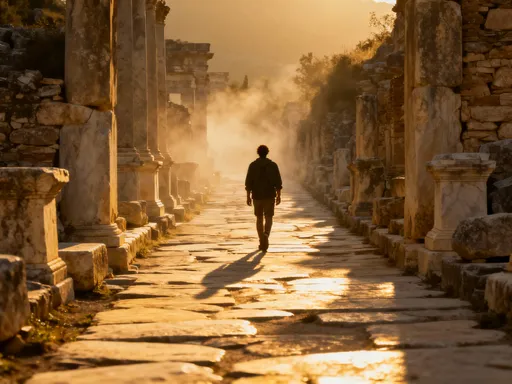
The Marble Road is the spine of Ephesus, a wide thoroughfare paved in gleaming white stone that once connected the harbor to the heart of the city. Though the sea has long since receded due to silt buildup, the road remains a powerful symbol of Ephesus’s former prosperity and strategic importance. Stretching over half a mile, it was more than just a path—it was the city’s main artery, pulsing with life during its peak in the first and second centuries CE. Today, walking along its polished surface, one can still feel the presence of those who came before: merchants hauling goods, senators in flowing robes, children chasing each other between columns.
What strikes most visitors is the craftsmanship. The marble blocks, quarried from nearby mountains, were cut with such precision that they fit together seamlessly, forming a smooth surface that has endured earthquakes, invasions, and centuries of weathering. Grooves worn into the stone by ancient cart wheels are still visible, offering tangible proof of daily activity. These marks are not damage—they are records. Each indentation tells of trade, movement, and the relentless rhythm of urban life. Archaeologists estimate that at its height, Ephesus was home to between 250,000 and 300,000 people, making it one of the largest cities in the Roman Empire. The Marble Road was where much of that life unfolded.
Along both sides of the road, remnants of colonnades rise like sentinels, once providing shade for pedestrians and space for shops and public announcements. The symmetry of the design reflects Roman ideals of order and civic pride. Public fountains, fed by an advanced aqueduct system, were placed at intervals, allowing citizens to drink, socialize, and rest. This attention to urban planning reveals a society that valued both function and beauty—a city built not just for survival, but for dignity.
For modern visitors, especially women who manage complex households and schedules, the Marble Road offers a quiet lesson in endurance and structure. Just as the road supported the weight of an entire civilization, so too do women often carry the invisible weight of family and community. Walking this path, one may begin to see parallels—not in grandeur, but in quiet strength. The road does not shout; it simply is. And in that stillness, there is power. To walk it mindfully is to remember that legacy is not always loud, and impact is not always immediate.
Side Streets and Hidden Corners: Discovering the Human Scale
Away from the grandeur of the Marble Road, Ephesus reveals a more intimate side. Narrow side streets branch off like veins, leading to residential neighborhoods where ordinary people once lived, cooked, argued, and loved. These areas are often overlooked by hurried tourists, yet they offer some of the most moving insights into ancient life. Here, one finds not temples or libraries, but homes with hearths, courtyards with wells, and bakeries with ovens still intact. The scale is human, the details personal—doorways low enough to duck under, stairs worn uneven by generations of feet, walls that once held family portraits and children’s drawings.
The Terrace Houses, located on the slopes of Mount Bülbül, are among the best-preserved examples of domestic architecture in the ancient world. These multi-level homes belonged to the wealthy elite, featuring mosaic floors, frescoed walls, and private water systems. But even in these luxurious dwellings, the focus was on daily living—light filtered through open atriums, rooms arranged for conversation and comfort, kitchens designed for real cooking. What stands out is not opulence, but intentionality. Every space was crafted for human use, for family life, for the rhythms of day and night.
Further down the hill, simpler homes tell another story. Built from local stone and mud brick, these dwellings had shared walls, narrow windows, and communal water sources. Yet they were not crude. Drainage systems, some still functional, show a sophisticated understanding of hygiene and urban planning. Door placements suggest cultural norms around privacy and social interaction—facing away from busy lanes, opening into private courtyards. These subtle design choices reflect values that resonate even today: respect, modesty, community.
For women who have spent years creating homes and nurturing environments for their families, these spaces can feel strangely familiar. The ancient Ephesian mother lighting an oil lamp, kneading bread in a clay oven, or washing clothes in a courtyard—her life may have been shaped by different tools and customs, but her concerns were universal: safety, warmth, connection. Standing in these quiet lanes, one can almost hear the echoes of lullabies, laughter, and whispered conversations. Ephesus, in these moments, becomes not a ruin, but a mirror.
The Agora and Social Life: Where Citizens Connected
The Commercial Agora of Ephesus was the city’s beating heart—a vast open space surrounded by colonnades, shops, and administrative buildings. More than just a marketplace, it was a center of civic life, where people gathered not only to trade goods but to exchange ideas, settle disputes, and celebrate festivals. Measuring approximately 160 by 140 meters, it could accommodate thousands, making it one of the largest agoras in the ancient world. Today, its remains—scattered columns, foundation stones, and reconstructed sections—invite visitors to imagine the vibrant energy that once filled this space.
Goods from across the Mediterranean flowed through the Agora: spices from the East, grain from Egypt, olive oil from local groves, wool from Anatolian flocks, and pottery crafted by local artisans. Stalls lined the interior colonnades, each occupied by a merchant shouting prices, weighing goods, or bargaining with customers. The air would have been thick with smells—fresh bread, fish, leather, and incense—while the sounds of haggling, laughter, and music created a constant hum. Public announcements were made from raised platforms, ensuring that news, laws, and religious decrees reached the people directly.
But the Agora was not just about commerce. It was also a place of social cohesion. Neighbors met here daily, forming bonds that strengthened the fabric of the city. Philosophers debated in shaded corners, teachers gathered students, and children played between stalls. The presence of public latrines and fountains indicates that the space was designed for extended stays, encouraging lingering and interaction. This emphasis on shared space reflects a worldview in which community was central to well-being—a value that many modern women, especially those raising families in increasingly isolated societies, may find deeply meaningful.
The Agora also housed administrative offices, where city officials managed taxes, land records, and legal matters. Inscriptions found on-site reveal the names of magistrates, guilds, and civic associations, offering glimpses into the governance of daily life. Women, though not typically in official roles, were active participants in the social and economic life of the Agora. As sellers, buyers, or representatives of household needs, they shaped the marketplace in quiet but essential ways. Their presence, though less documented, was no less real.
Celsus Library and the Illusion of Silence
Rising at the end of the Marble Road, the Library of Celsus stands as one of Ephesus’s most iconic structures. Its ornate two-story facade, with Corinthian columns, statues in niches, and intricate carvings, is a masterpiece of Roman architecture. Built in the 2nd century CE to honor Tiberius Julius Celsus Polemaeanus, a Roman senator and former governor of Asia, the library once housed an estimated 12,000 scrolls. Though the interior is now lost—destroyed by fire and earthquake—the exterior remains a powerful symbol of knowledge, memory, and cultural pride.
What many visitors don’t realize is that the library was not just a repository of books. It was also a monument, a mausoleum, and a public space. Celsus was buried in a sarcophagus beneath the building, his ashes resting below the very institution that bore his name. This fusion of tomb and library speaks to a worldview in which legacy was tied to intellectual contribution. Knowledge was not just preserved—it was honored, almost sacred. Scholars, citizens, and travelers would have entered to read, copy, or discuss texts on philosophy, history, and science, contributing to a culture of learning that extended far beyond Ephesus.
The acoustics of the facade, though not part of the original interior, still carry whispers of the past. On quiet mornings, when the site is nearly empty, one can stand before the library and feel the weight of silence—not emptiness, but fullness. It is the silence of concentration, of deep thought, of voices long gone but not forgotten. The niches that once held statues of personifications—Wisdom, Thought, Intelligence, and Excellence—remind us that the Ephesians valued not just information, but the virtues that guided its use.
For women who have spent years absorbing knowledge—through parenting, managing households, learning new skills, or returning to education—the Library of Celsus can feel like a quiet affirmation. Their learning may not be recorded on scrolls, but it is no less real. The library, in its stillness, honors the unseen labor of understanding, the quiet moments of decision-making, the lifelong process of becoming wiser. It stands as a reminder that wisdom does not require fanfare to be valuable.
Modern Ephesus: Living Among Ruins
While the archaeological site of Ephesus captures the imagination, the surrounding region tells a different kind of story—one of continuity. The nearby town of Selçuk, home to about 40,000 people, thrives in the shadow of the ancient city. Farmers tend fields that have been cultivated for millennia. Artisans sell handwoven textiles, ceramics, and olive oil—goods that echo the economy of Ephesus itself. Local cuisine, based on fresh vegetables, grains, and dairy, reflects a diet that has changed little over centuries. This living connection between past and present is subtle but powerful.
Tourism plays a major role in the local economy, bringing both opportunity and challenge. Many families run small guesthouses, restaurants, or guided tours, allowing them to share their heritage while supporting their livelihoods. Some residents speak multiple languages, not out of academic training, but out of daily necessity. Children grow up knowing the ruins as part of their backyard, playing near columns that predate their nation. For them, history is not something studied in books—it is lived.
Yet there is also a deep sense of responsibility. Locals often express pride in Ephesus, not as a foreign attraction, but as a part of their identity. Elders recount stories passed down through generations—legends of saints, whispers of empires, memories of excavations. This cultural continuity ensures that the site is not just preserved in stone, but in spirit. When a woman in Selçuk bakes bread in a wood-fired oven or tends her garden with ancient techniques, she is not performing for tourists. She is simply living—unaware, perhaps, that she is also keeping history alive.
For visitors, especially women seeking authenticity in their travels, this connection is deeply moving. It reminds us that history does not end when civilizations fall. It lingers—in soil, in recipes, in gestures, in the way people greet each other at dawn. To see Ephesus only as a ruin is to miss half the story. The true wonder lies in how the past breathes through the present, quietly, steadily, like a river beneath stone.
How to Truly Immerse Yourself in Ephesus
To experience Ephesus fully, one must move beyond the checklist. It is tempting to rush through, ticking off the Library, the Temple of Hadrian, the Great Theater, and moving on. But the real magic of Ephesus unfolds slowly, in moments of stillness and attention. The best time to visit is early in the morning, when the sun is low and the air is cool. Arriving at opening time allows for solitude, a rare gift in a popular destination. Without crowds, the site feels more personal, more intimate, as if it is speaking directly to you.
Leave the map behind—at least for a while. Allow yourself to get lost in the side streets, to wander without purpose. Notice the texture of the stones, the way light falls across a courtyard, the sound of wind through broken columns. Sit down for a few minutes. Listen. Breathe. These small acts of presence can transform a visit from sightseeing to soul-seeing. Bring water, wear comfortable shoes with good grip, and take breaks in shaded areas. The site is large and uneven, and pacing yourself is essential, especially in summer heat.
Engage with local voices when possible. A conversation with a guide, a shopkeeper, or a resident can offer insights no brochure can provide. Ask about their lives, their families, their connection to the ruins. Many locals are happy to share, not as performers, but as neighbors. These exchanges humanize the experience, grounding ancient history in modern reality.
Finally, resist the urge to photograph everything. While capturing memories is natural, constant snapping can create a barrier between you and the moment. Instead, choose a few meaningful shots and spend more time simply being. Let the stories of Ephesus settle into your heart. When you leave, you may not remember every column or inscription, but you will carry something deeper: a sense of timelessness, a quiet awe, and the understanding that you, too, are part of an endless human story.
Conclusion
Ephesus is more than ruins—it’s a conversation across millennia. When you walk its streets, you’re not just seeing history. You’re stepping into its rhythm, hearing its whispers, becoming part of its endless story. The stones remember what we forget: that life, in all its simplicity and complexity, continues. For women who have given so much of themselves to family, home, and duty, Ephesus offers a rare gift—the chance to pause, to reflect, to remember that their own lives are part of a larger tapestry. Here, in the quiet alleys and sunlit plazas, one can find not just the past, but a deeper sense of belonging. To visit Ephesus is not to escape life, but to re-enter it—with new eyes, a fuller heart, and a renewed sense of place in the long, beautiful arc of time.